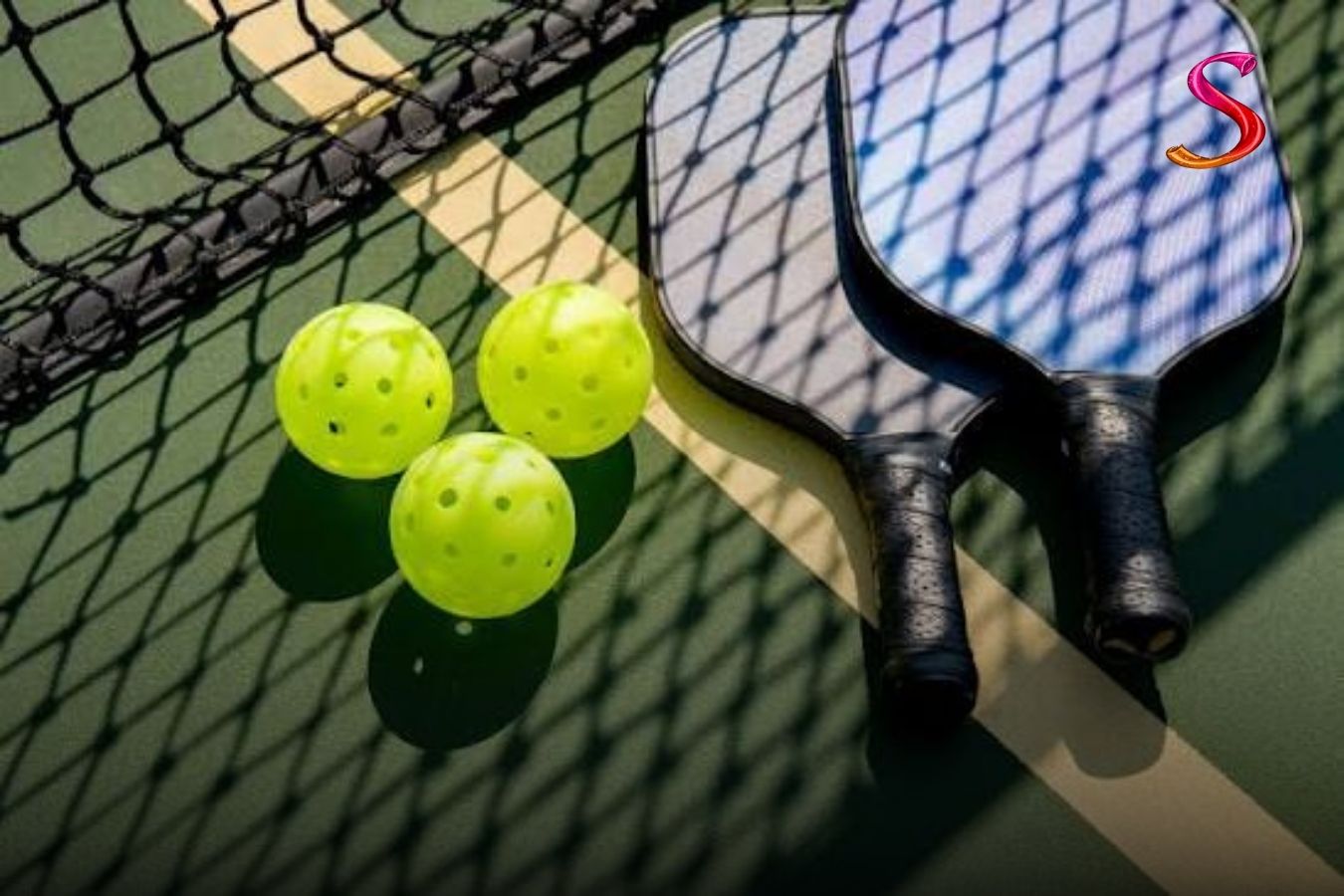
Ever wonder how pickleball players add a wicked spin to the ball’s trajectory? Well, when the pickleball paddle hits the ball with such strong force, it causes the ball to have a burst of speed, breaking through even the tightest defenses.
When a pickleball paddle strikes the ball with high force and a angled stroke, it creates rapid rotation alongside forward velocity. That “wicked” curve isn’t magic—it is pure physics, material science, and fluid dynamics at work, Lets break it down
The Mechanics: Kinetic Energy & Surface Friction
- The Strike: The paddle converts elastic strain energy into kinetic energy (speed).
- The Brush: Instead of striking flat, the player slides the paddle face across the ball. Modern composite paddles feature textured faces (like carbon fiber) that grab the seamless plastic ball.
- Torque: Friction between the paddle face and the plastic surface applies torque, converting part of the forward kinetic energy into rotational kinetic energy (spin rate/RPM).
Aerodynamics: The Magnus Effect Once airborne, fluid dynamics dictates the trajectory:
- As a spinning ball flies through the air, it drags a thin layer of air around itself.
- On the side spinning with the airflow, air moves faster, creating a region of low pressure.
- On the side spinning against the airflow, air slows down, creating a region of high pressure.
The Ball Factor: Perforations and Rigidity Unlike a fuzzy tennis ball, a pickleball is smooth polymer plastic with smooth-molded holes. Air moving through these perforations creates micro-turbulence, which slightly resists spin compared to a felt ball. Consequently, generating extreme spin in pickleball requires higher paddle friction, faster hand speed, and aggressive brush angles.